
On Tuesday, February 4th, the Hunting Federations of Asturias, Castile and León, Cantabria, and Galicia, the Biodiversity Foundation, and the Brown Bear Foundation (FOP) presented an information and awareness campaign aimed at hunters at the headquarters of the Royal Spanish Hunting Federation (RFEC) to ensure that hunting activities run smoothly and are compatible with brown bear conservation. The campaign is part of the information, training, and awareness-raising activities for stakeholders and interest groups within the LIFE Project «Bears with a Future,» coordinated by the FOP. The presentation was attended by Josep Escandell, president of the RFEC; Víctor Gutiérrez, coordinator of the Ecosystem Conservation and Restoration Area of the Biodiversity Foundation of MITECO; Luis Eusebio Fidalgo, representative of the Galician Hunting Federation; and Guillermo Palomero, president of the Brown Bear Foundation.
In his speech, Josep Escandell emphasized the importance of conservationists and hunters, «entities that were once perceived as antagonistic, cooperating and working for decades» for the conservation of the brown bear and the development of hunting practices in these bear-producing areas. In this regard, he advocated continuing to promote these good practices «to avoid future accidents involving bears» and to put an end to poaching, a type of crime «that has nothing to do with hunting and that tarnishes the name of good hunters, who have been involved for years in the conservation of species such as the bear, the lynx, and the imperial eagle, among others.»
For his part, Víctor Gutiérrez highlighted the importance of cooperation between administrations, sectors, and civil society to address the challenges of the climate crisis and biodiversity loss. “It is essential that we all promote climate change adaptation measures that make it possible to reconcile socioeconomic activities with the conservation of natural values,” Gutiérrez emphasized.
Luis Eusebio Fidalgo emphasized the importance of brown bear conservation and maintaining collaboration among all sectors with interests in the natural environment. He added that “it is essential to respect the uses and customs of the natural environment so that everyone (ranchers, farmers, hunters, beekeepers, etc.) can harmoniously combine their activities with the presence of the bear and the recovery of the species.”
Furthermore, in addition to congratulating the Brown Bear Foundation for the recovery of the bear population on the Cantabrian coast, he stated that “guaranteeing the recovery of the species also requires establishing the environment’s capacity to sustain it and, when necessary, taking appropriate management measures to ensure the growth of the species while avoiding conflicts between different groups.”
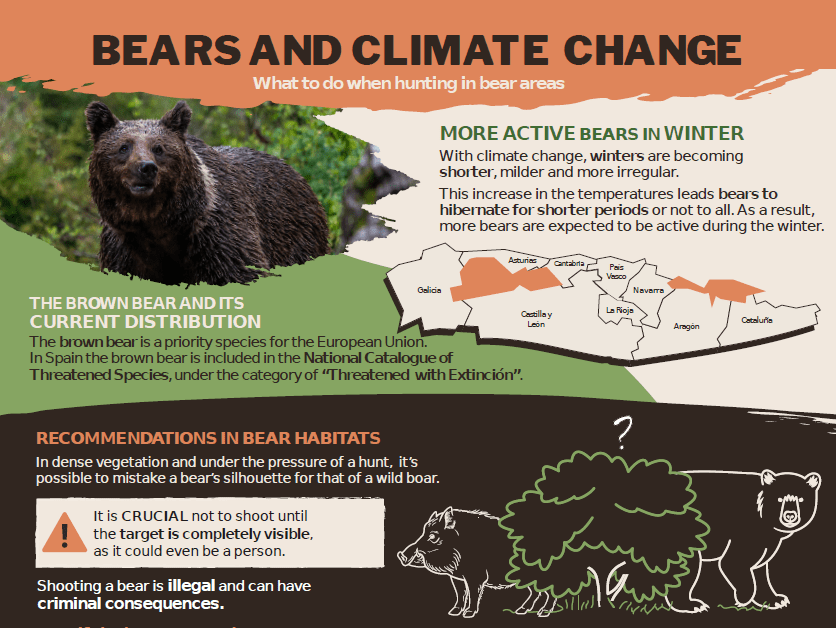
Finally, Guillermo Palomero emphasized that the Cantabrian landscape is changing due to climate change, and «we have bears active throughout the entire wild boar hunting season during a drive. This is something that Cantabrian hunters need to know, as well as how to react to the presence of bears during a drive. To this end, we work together with hunting federations to provide information to as many hunters as possible and ensure safe hunting in the bear forests.»
Finally, the presidents of the hunting federations participating in the campaign spoke, delivering messages that, in summary, stated that the brown bear is no longer in critical danger of extinction thanks to the joint work of many stakeholders, including the long-standing commitment of hunting federations. We now have more bears and they no longer feel so persecuted. This forces the sector to make efforts to prevent incidents between hunters and bears and ensure hunting activities compatible with the presence of bears.
Hunting has always been a deeply rooted social activity in bear-hunting territories. Therefore, for years, Cantabrian hunting associations and federations and the FOP have been working together to improve hunting practices in bear-hunting territories by publishing hunting manuals for bear areas, equipping and training game wardens, clearing hunting positions, and searching for and removing illegal snares, among other campaigns and actions.
THE PROJECT «LIFE BEARS WITH FUTURE»
The LIFE Project «Bears with a Future» aims to improve the brown bear’s adaptability to climate change in the Cantabrian Mountains, contributing to achieving a Favorable Conservation Status for the species in the medium and long term. This project takes an ecosystem approach and promotes best practices and solutions that favor the expansion of bears’ food resources and the prevention of conflicts with human activities.
In line with this objective, work has already been done, for example, to contribute to improving food availability in climate change scenarios by planting and managing small groves of native species that produce summer and winter fruits for bears and are low in climate vulnerability, to offset the expected reduction in other food resources. To date, 110,000 fruit trees and 12,000 native chestnut trees have been planted within the framework of this project.
Another objective of the project is to inform and raise awareness among stakeholders who may be involved in greater conflicts with bears due to their reduced tendency to hibernate, providing advice and guidance for developing winter activities in bear-producing areas. The campaigns have been specifically targeted at mountaineers, mycologists, nature photographers, and, in this case, hunters, leveraging the reach of these groups’ federation movement.
The «Bears with a Future» project, co-financed by the European Union’s LIFE program, is coordinated by the Brown Bear Foundation and has as partners the Biodiversity Foundation of the Ministry for Ecological Transition and the Demographic Challenge and the Natural Heritage Foundation of Castilla y León, an entity dependent on the Ministry of Environment, Housing and Territorial Planning of the Regional Government of Castilla y León. It is supported by the Government of Asturias, through the General Directorate of the Natural Environment and Rural Planning of the Ministry of Rural Development, Livestock and Fisheries, as well as the Tierra Pura Foundation.